
Retention Systems
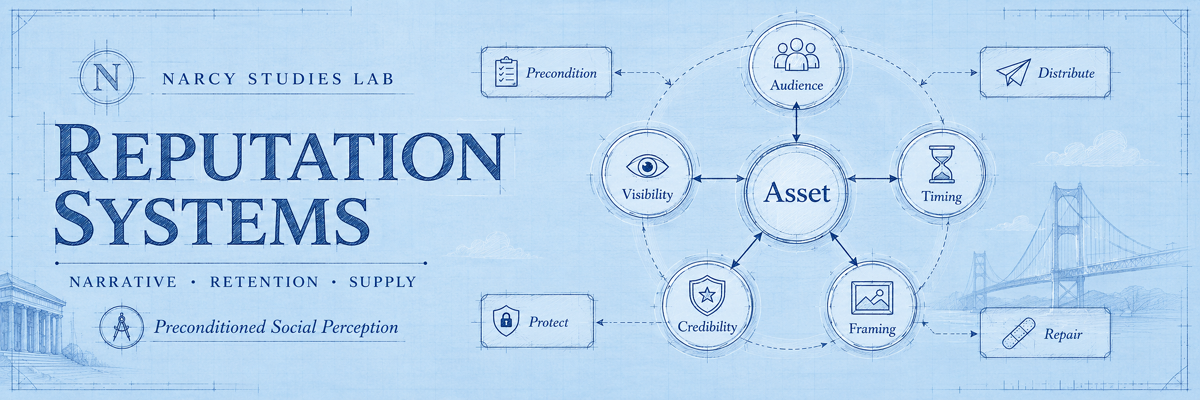
Reputation Systems
Narrative · Retention · Supply
Core idea: Reputation systems can prepare the social conditions in which later events will be interpreted by managing what is presented, to whom, when, and under what frame.
Reputation is not only what people think after an event. Structurally, it can function as an ongoing social-perception system that begins before conflict, continues during retention, activates during settlement failure or separation, and may be repaired during re-entry or hoovering.
In this framework, the “asset” is the person, relationship, role, event, or account whose social meaning is being managed. The operator can influence delivery, audience, timing, visibility, and framing; the operator cannot fully control what another person ultimately believes. The purpose of the map is to observe the architecture of perception management without assuming intent, pathology, or diagnosis.
The Reputation System sits across existing NarcyNarc systems rather than replacing them. Narrative supplies the account. Retention can benefit when the account preserves access, discourages disengagement, or supports re-entry. Supply can be generated through attention, validation, sympathy, allegiance, information, and social reinforcement. Compartmentalization can keep audiences separated, while Settlement Failure can become a context in which reputation material is introduced, repeated, or contested.
A reputation system may be quiet for long periods. Its structure becomes easier to see when the same social field is repeatedly prepared, activated, defended, or repaired across changing relationship states. One ordinary act of explaining oneself is not the pattern; repeated management of audience interpretation is the structural signal.
Start with observable delivery. Track what information was released, which audience received it, what frame accompanied it, whether contradictory information could travel, and how the account changed after conflict, separation, or attempted repair.
Do not begin with “Is this a smear?” Begin with “What was placed into the social field, where was it placed, and what did that placement make easier to believe later?” Compare events over time before assigning motive.
A Reputation System is a social-facing architecture that attempts to precondition, distribute, protect, or repair perception of an asset across audiences and relationship states. Its strongest structural signature is not simply negative speech; it is repeated management of the conditions under which later information will be received.
The smear is visible. The reputation system that made the smear believable may not be.
This study examines Reputation Systems as a whole. The Structural Field Cards isolate the individual features inside that architecture so they can be observed, compared, and mapped without requiring the reader to assume motive.
Beyond the individual features:
the larger Reputation architecture becomes visible when several functions interact across time, audiences, and relationship states.
Valence-Neutral Architecture
building · softening · damaging · defending · repairing
Reputation activity is not synonymous with smear behavior. The same social-facing architecture can build favorable standing, soften uncertainty, stabilize credibility, challenge an existing account, damage standing, or help restore it after conflict.
Structural Insight:
Smear behavior is one negative expression inside a broader Reputation System. A smear campaign is a more concentrated distribution state in which negative material is repeatedly circulated, reinforced, and socially carried across additional people or channels.
The architecture is identified first by what happens to perception—not by assuming why it happened.
Concurrent Activation
overlap · multiple audiences · simultaneous functions
Reputation functions do not have to activate one at a time. Seeding can continue with one audience while social proof is borrowed from another, amplification occurs elsewhere, and contradiction is being contained in a different part of the social field.
Structural Insight:
The system is better understood as a field of simultaneously available functions than as a forced linear sequence.
A later repair effort can even become fresh seeding for a new audience: “I made mistakes, but I have grown” may repair one relationship while establishing an early reputation frame in another.
Open Compartmentalization
separable positions · different frames · no secrecy required
Different audiences can hold different reputation assignments without anyone being hidden. One group may receive favorable positioning around a current relationship while former relationships are grouped under a negative or cautionary explanation.
Structural Insight:
Compartmentalization does not require secrecy. It requires separable structural positions. The rooms may all be visible while still receiving different information, expectations, credibility, and interpretive frames.
A compartment can later change classification without a breach: the person once framed as “different” can eventually be moved beneath the same umbrella previously assigned to former relationships.
Reputation Buffer
accumulated credibility · benefit of the doubt · softened evaluation
Favorable reputation cues can accumulate until later ambiguous behavior is interpreted through existing credibility rather than evaluated from a completely fresh starting point. That buffer can arise naturally through demonstrated reliability or through repeated social positioning.
Structural Insight:
Reputation Seeding can establish an early expectation; accumulated credibility can later become an interpretive buffer around self-directed choices, allocation changes, accelerated relationships, or other events that might otherwise receive closer evaluation.
Early favorable positioning → accumulated credibility → later ambiguity receives a more favorable default interpretation.
Narrative Revision, Transfer & Social Carrying
revised account · intermediaries · circulation · retention
A reputation account can change while older versions are still circulating. Narrative Revision alters the account; Narrative Transfer moves that account into another person; Social Proof Borrowing and Reputation Amplification can then give the revised version additional reach or weight.
Structural Insight:
An intermediary can become both social proof and distribution infrastructure. When third parties are used to influence how one relational position interprets another, the same structure may also intersect with Triangulation.
Compartmentalization separates the audiences. Narrative Revision changes the account. Narrative Transfer moves the account. Reputation determines its social weight. Retention can benefit when the transferred account helps preserve access, allegiance, or an existing arrangement.
Recognition, Boundary Erosion & Genuine Repair
early recognition · direct response · accountability · changed pattern
Structural awareness is not useful only after damage has occurred. Early recognition can create an opportunity to interrupt a developing pattern before it becomes normalized. A boundary named early may be easier to reinforce than one that has been repeatedly eroded without acknowledgment.
Structural Insight:
Slowing an accelerated process, naming an observed boundary change, comparing accounts directly, restoring direct communication, or asking for clarification can change what happens next. Reputation Repair becomes especially meaningful when social repair is accompanied by observable accountability, respected boundaries, corrected behavior, and durable change.
The public image took a dent. Out come the explanations, the growth story, the mutual-mistakes package, maybe a fresh coat of humility. Could be genuine repair. Could be reputation bodywork. The pattern is what tells you which garage you’re in.
Collective Observation
The Structural Field Cards identify the individual features. This Lab study examines what becomes visible when those features operate together across audiences, compartments, and time.
The Structural Field Cards identify the individual features. This Lab study examines what becomes visible when those features operate together across audiences, compartments, and time.
Recognition does not guarantee correction, but it creates an opportunity for correction to become observable.
Reputation is a cross-system architecture. Narrative organizes the account; Retention can benefit from preserved access or re-entry; Supply can be produced through attention, validation, sympathy, allegiance, and social reinforcement. Settlement Failure and Compartmentalization can become important delivery contexts without becoming the Reputation System itself.