
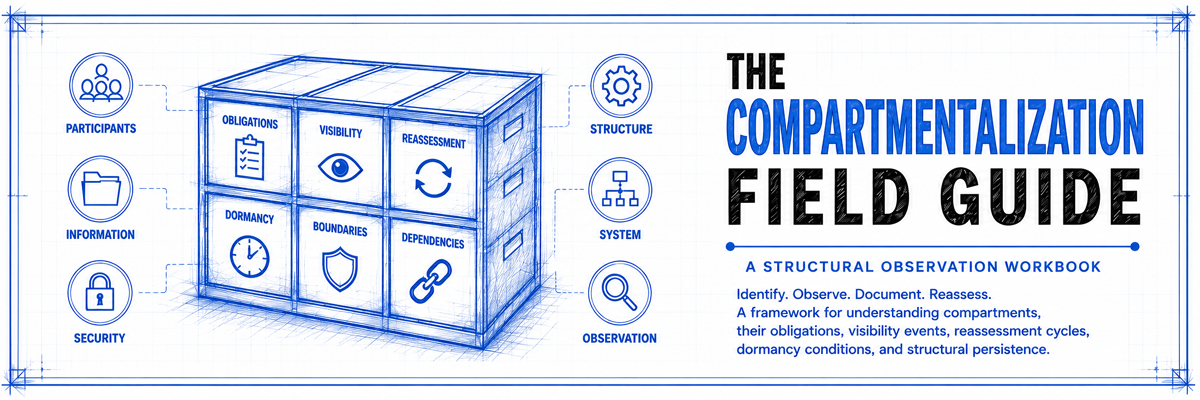
The Compartmentalization Field Guide
This guide is not intended to determine whether a compartment is benign, necessary, risky, protective, inefficient, ethical, unethical, or secretive.
This guide is not a manual for creating, maintaining, expanding, or managing compartments. It is a field guide for observing compartment structures.
Understanding often develops through comparison over time rather than through any single observation.
Part I — Orientation
What Is A Compartment?
A compartment isn't the stuff inside the room. It's the room.
Everybody notices the furniture. Structural observers notice the walls. Activities, obligations, participants, resources, and information may all change, but the surrounding structure often explains far more than the contents.
What Is Not A Compartment?
Not every activity constitutes a compartment. A compartment typically exhibits one or more of the following: distinct boundaries, independent obligations, independent participants, separate allocation requirements, periods of activity and inactivity, or observable maintenance.
Patterns are generally more informative than individual events.
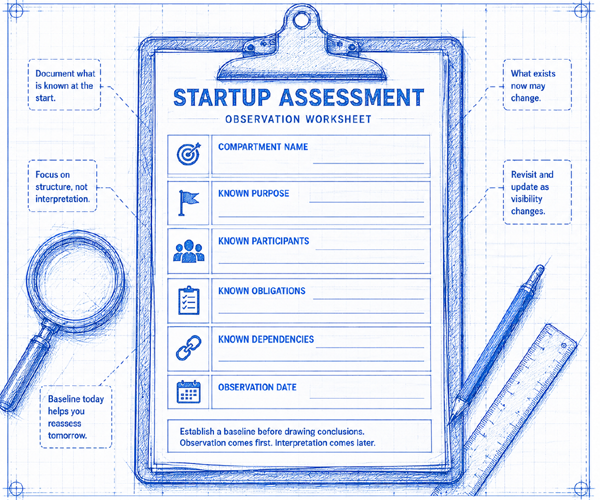
Startup Assessment
Many observations focus on current conditions. Field observations should also consider startup conditions.
Structures remember how they started. People usually judge today's condition. Structural observers ask what the startup looked like, because the beginning often explains what comes later.
Boundary Assessment
Every compartment possesses boundaries. Some boundaries are highly visible. Others may be inferred through observation.
Risk Assessment
Compartment risk is influenced by obligation count, dependency count, participant count, visibility pathways, disclosure pathways, and boundary complexity.
Startup conditions often influence future stability.
Part II — Obligation Expansion & Maintenance
Few compartments remain unchanged after startup. New obligations emerge. Participants change. Dependencies evolve. Visibility increases or decreases.
The observer's task is not to determine whether change is good or bad. The observer's task is to identify what changed.
Obligation Expansion
An obligation is any condition requiring ongoing allocation, attention, maintenance, participation, or response.
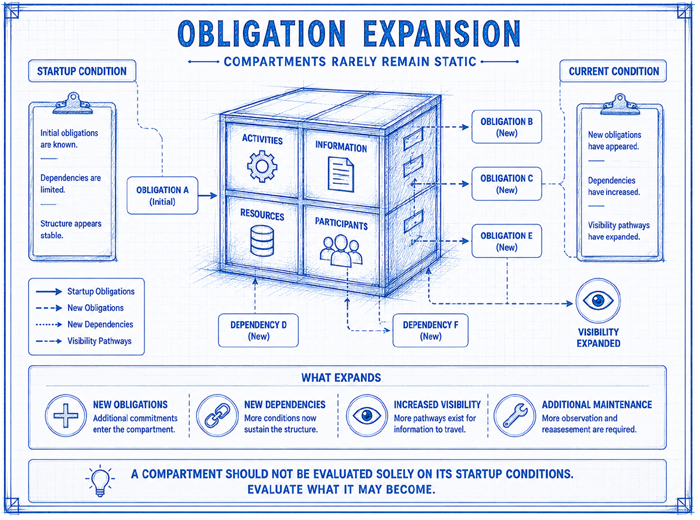
Expansion Indicators
Signs of obligation expansion may include increased allocation, increased scheduling, increased dependency, and increased maintenance.
More doesn't automatically mean worse. It simply means something was added. Another obligation. Another participant. Another dependency. Systems usually grow one responsibility at a time.
Structural Drift
Over time, compartments may gradually differ from their original design. This process may be referred to as structural drift.
Understanding often begins by identifying what changed after startup.
Observers often focus on the existence of a compartment.
Part III — Visibility Events & Reassessment
Observers often assume that change begins when a compartment changes. In many cases, change begins when information becomes visible.
The compartment may remain unchanged. The observer's understanding of the compartment changes.
What Is A Visibility Event?
A visibility event occurs when previously unavailable information becomes available to an observer.
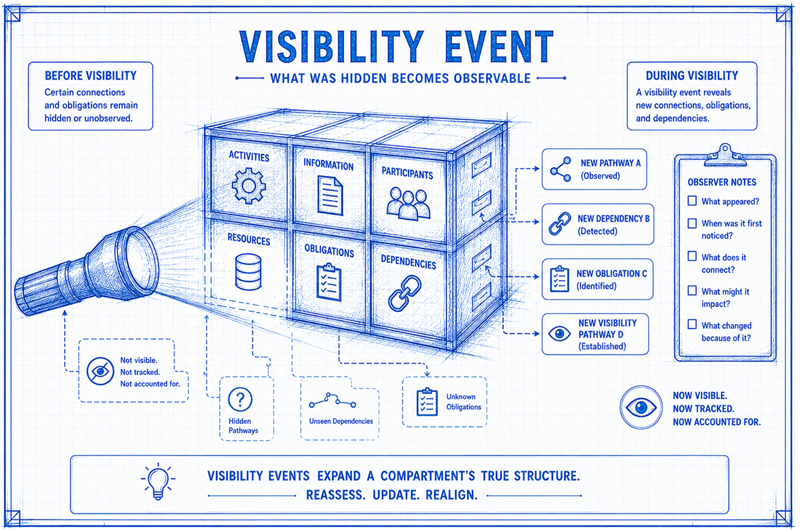
Visibility Does Not Equal Change
Here's where observers get fooled. Something becomes visible and the mind says, “It just happened.” Maybe not. Visibility changes what you know. It does not necessarily mean the structure just came into existence.
Observer Warning — Reciprocal Compartments
Some compartments may exist as reciprocal compartments within separate structures. In these cases, Structure A contains a compartment representing Structure B, while Structure B contains a compartment representing Structure A.
Because two structures are involved, complexity may increase. The observer should avoid assuming that reciprocal compartments operate identically to independent compartments.
Structural Stress
Structural stress occurs when existing assumptions no longer align with observed conditions, previous models require revision, new information introduces complexity, or reassessment becomes necessary.
Stress does not indicate failure. Stress indicates adjustment.
Visibility events do not necessarily change compartments.
What became visible
and
What actually changed.
Part IV — Dormancy, Termination & Structural Persistence
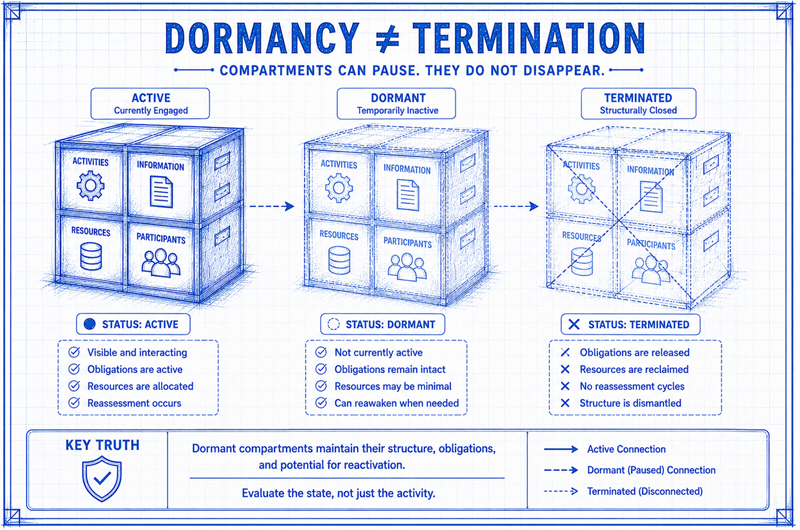
Observers often assume that reduced activity indicates elimination. This assumption may not always be accurate.
A compartment may experience reduced activity while remaining structurally present.
Dormancy
Quiet doesn't mean gone. Activity can slow down while the compartment is still sitting there. A garage gets quiet when the car leaves. Nobody assumes the garage disappeared.
Termination
Termination occurs when the compartment itself ceases operation. Termination should not be assumed solely because activity decreases.
Dormancy vs Termination
A useful observation question is: “Has activity stopped?” A more useful structural question may be: “Has the compartment stopped existing?”
The observer should distinguish between what is visible and what still exists.
Observers frequently monitor activity.
Structural observers watch existence.
A compartment may disappear from view while remaining structurally present.
What is visible
and
What still exists.
Part V — Building a Structural Timeline
Individual observations often answer immediate questions. Documented sequences often answer different questions.
The Compartment Interaction Journal is designed to preserve chronology rather than rely upon memory. Each timestamped observation becomes part of a developing structural timeline.
What to Watch For Over Time
As observations accumulate, readers may begin noticing recurring participants, repeated mentions, omitted participants, information allocation, fragmentation, timeline discrepancies, visibility events, expanding obligations, changing boundaries, dormant structures, and recurring communication pathways.
The registry does not determine what these observations mean. It preserves observations so later comparisons are made against documented chronology rather than recollection.
Field Exercises — Put the Guide to Work
You just finished reading the guide. No need to drag you back through every paragraph as though the last ten minutes vanished. The structure is still fresh. Open the Journal, choose the exercise that matches what you are observing, and build the chronology.
The exercises do not ask the Journal to decide what anything means. They simply give the observer a disciplined place to record what changed, what became visible, and what remained structurally present.
Structures often become easier to understand when separated from assumptions, narratives, and conclusions.
Time preserves sequence. Comparison builds understanding.