
Retention Systems
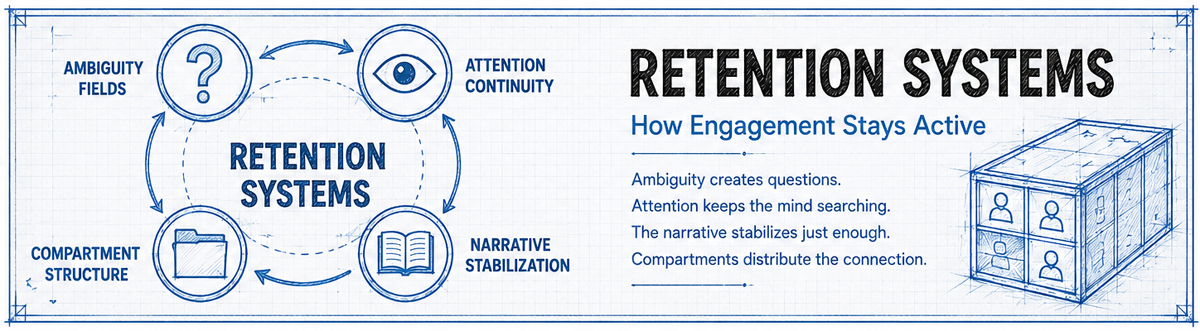
This page maps retention as a system.
Instead of focusing on a single event, this framework follows how ambiguity, attention, narrative, and compartment structure interact over time.
The goal is not to label someone. The goal is to see how the system holds.
Retention does not always require direct control.
Sometimes the system holds through unresolved questions, delayed clarity, partial disclosure, softened explanations, emotional activation, or compartment structure. The target keeps thinking, checking, wondering, comparing, or waiting for the version that finally makes sense.
Move through the layers slowly.
You are not trying to prove everything at once. You are learning to recognize which part of the system is keeping attention active.
If one layer stands out, pause there. That is where the value is.
Not one event.
A retention system.
The structure holds attention over time.
Reflex Pressure
reaction · strain · visible activation
When the system gets squeezed... it reacts.
Don't stop there. The real question is:
What remained active after the reaction ended?
Don't stop there. The real question is:
What remained active after the reaction ended?
Mechanic:
A reaction may briefly discharge pressure, but retention usually continues after the reaction through narrative repair, ambiguity, or renewed attention.
Example:
A sharp reaction happens, then the story softens afterward so the target keeps processing rather than fully disengaging.
Narrative Stabilization
softened story · partial clarity · PG version
The story doesn't have to solve everything.
Enough truth to calm things down. Not enough to close the file.
Enough truth to calm things down. Not enough to close the file.
Mechanic:
Provide enough explanation to reduce immediate rupture without fully resolving the underlying ambiguity.
Example:
A partial explanation calms the moment but leaves enough unanswered that the target keeps thinking.
Ambiguity Activation
attention · uncertainty · open loops
Ever notice how unanswered questions keep following you around?
An open loop can hold attention long after the conversation ends.
An open loop can hold attention long after the conversation ends.
Mechanic:
Uncertainty keeps the mind engaged. The target may continue filling gaps, comparing versions, or searching for the missing context.
Example:
The “PG version” keeps questions alive while the deeper version remains out of reach.
Compartment Structure
anchor · compartments · rotation
Different people. Different jobs. Different versions.
Mechanic:
The anchor stabilizes the system. Compartments create distribution. Retention depends on keeping the structure intact enough to continue functioning.
Example:
One person may receive reassurance, another ambiguity, another charm, and another silence — while the larger structure keeps operating.
System Objective
continuity · access · multi-compartment gain
They're not always trying to win the argument.
If attention stays in the system, the system is still working.
If attention stays in the system, the system is still working.
Mechanic:
The system does not always need full control
. It only needs enough sustained attention to keep the relational structure active.
Example:
The target may not be fully convinced, but if attention remains engaged, the retention system is still partially working.
They're not always trying to hold on tightly. Sometimes they're just trying to make sure you don't completely let go.
Now Look at the Layer Distinctions
Reflex Pressure
→
“What reaction appears when the system is strained?”
Narrative Stabilization
→
“How is the story softened enough to continue?”
Ambiguity Activation
→
“What keeps attention unresolved and active?”
Compartment Structure
→
“How are roles, access, attention, or validation distributed?”
System Objective
→
“What continuity does the system preserve?”
This is why retention can feel confusing: the system may not be trying to resolve the relationship. It may be trying to preserve attention, access, and continuity.
Retention systems often operate through what remains unresolved.
The missing detail, the softened explanation, the delayed answer, the open loop, the compartment gap, or the carefully limited version may keep the target engaged longer than a direct argument ever could.
Recognition improves when the observer stops asking only what happened and starts asking what stayed active afterward.
That shift turns confusion into retention mapping.