Narcy Studies Lab
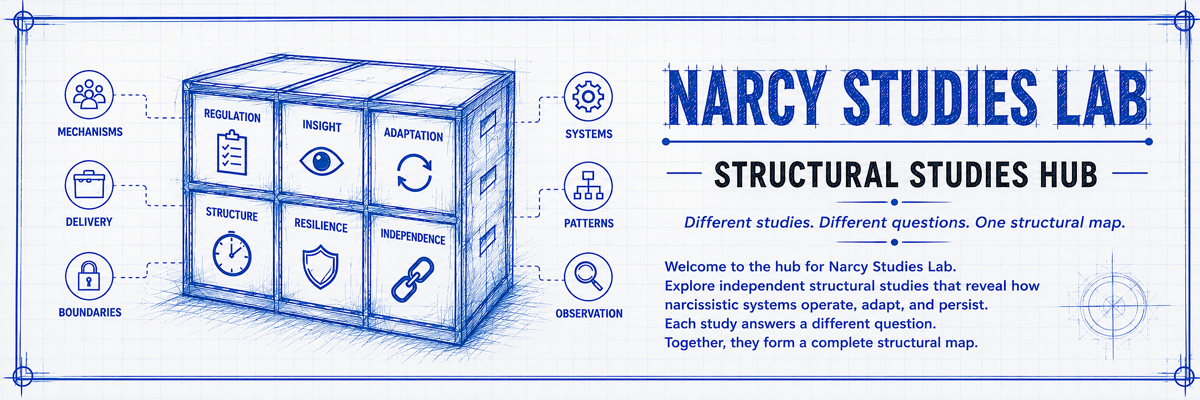
The Lab contains independent structural studies. Each study asks a different kind of question. You do not have to enter through one fixed door. Start with the study closest to what you are trying to understand, then branch at your own pace.
Tiered Regulation Mapping
Maps regulation from immediate reflexive responses through narrative, structure, strategy, and system-level integration.
Mechanisms & Delivery-State Architecture
Separates the underlying mechanism from the emotional delivery state carrying it, then maps calibration, target adaptation, boundary feedback, and adjustment over time.
Retention Systems
Some systems do not rely on constant conflict. They rely on continuity. This study examines how ambiguity, narrative, compartment structure, and attention can help maintain structural persistence over time.
The Compartmentalization Field Guide
A practical field guide for identifying, documenting, and reassessing structural compartments. It examines how startup conditions, visibility events, obligations, reassessment cycles, and dormancy influence compartment stability.
The Architecture of Regained Agency
Recovery is more than leaving a difficult situation. This study follows the structural progression from recognition and orientation through restored agency, boundary reintegration, and autonomous operation.
Reputation Systems
Examines how reputation can be seeded, weighted, distributed, protected, challenged, and repaired across audiences and relationship states. The study follows the larger architecture first, then leads into the individual Reputation Structural Field Cards.
Structural Field Cards
Introduces the Structural Field Card framework—a practical method for classifying observations before interpreting them. Learn how collections, classifications, structural placement, and field guidance work together to support thoughtful pattern recognition.