The Architecture of Regained Agency
Recognition · Orientation · Autonomous Operation
Core idea: Recovery can be understood as the gradual restoration of independent operation after attention, delivery, and decision-making have been reorganized around anticipated reactions.
The Mechanisms & Delivery-State Architecture page explains how mechanisms, delivery states, and repeated adaptation may influence attention, perception, and decision-making over time.
This page examines the same architecture from the target's point of view. Rather than asking how a retention system operates, it asks how structural awareness can gradually restore independent operation. Recovery is not treated here as a single emotional event. It is treated as a progression of regained agency.
Regained agency does not usually begin with certainty. It often begins with recognition: a moment when something no longer fits, a pattern becomes noticeable, or a familiar reaction begins to feel questionable.
Within the Narcy Studies Lab framework, organization often precedes clarity. The question shifts from "What does this mean?" to "Where does this belong?" That shift moves attention away from endless interpretation and toward structural awareness.
Use this page as an orientation map, not a diagnostic tool. The stages below are not rigid steps, clinical claims, or proof of another person's intent. They are a structural way to describe how recognition, clarity, agency, and boundaries may gradually return.
Structure first. Interpretation later. The goal is not to accuse. The goal is to recover direction, stabilize reality, and preserve the ability to make informed choices.
Not just tactics.
Recovery architecture
describes how independent operation may return after attention and decision-making have been shaped by anticipated reactions.
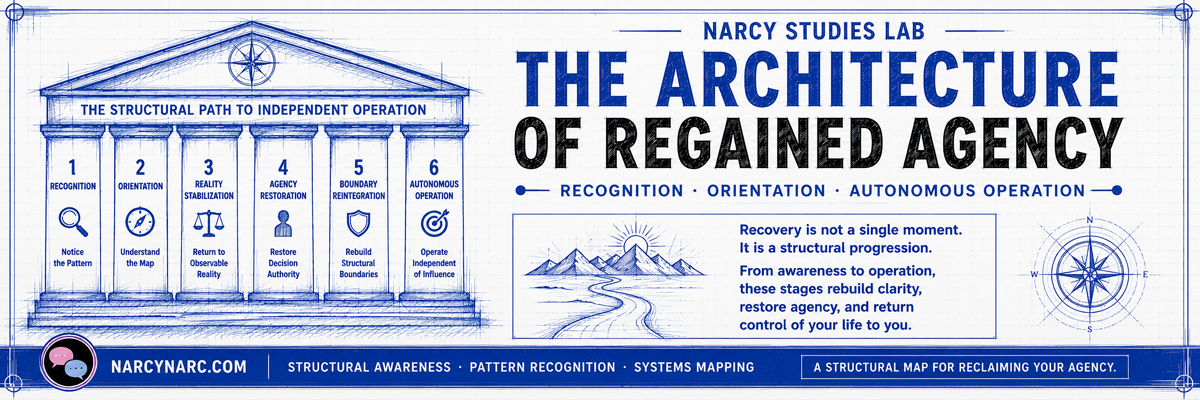
Recognition
pause · notice · question
Something doesn't sit right anymore.
Just that little voice saying...
Just that little voice saying...
Mechanic:
Recognition interrupts automatic adaptation. The observer does not have to prove what is happening. The first movement is simply noticing that the event deserves closer attention.
Example:
A familiar request creates an internal pause: "Wait... why does this feel organized around their reaction?"
Orientation
locate · classify · map
This is where the map finally becomes useful.
Mechanic:
Orientation reduces unstructured uncertainty by providing direction. A tactic, mechanism, system, or outcome can be located without requiring immediate accusation or certainty.
Example:
A questionable event is compared against a Structural Field Card, then placed within a possible retention, narrative, supply, or boundary system.
Reality Stabilization
signal · evidence · reduced fog
Your brain finally gets a day off.
Mechanic:
Stabilization restores signal integrity. Rumination may decrease as the observer begins organizing events by pattern, context, and structural function rather than by emotional intensity alone.
Example:
Instead of asking "Was I wrong?" repeatedly, the observer asks "What pattern keeps repeating, and what does it appear to influence?"
Agency Restoration
choice · evaluation · self-direction
Little by little, you stop organizing decisions around anticipated reactions and start asking, “What do I actually think?”
Mechanic:
When anticipated reactions increasingly influence information delivery and decision-making, the delivery state itself may begin to reorganize around those anticipated reactions. Agency restoration begins reversing that process.
Example:
A person notices they have been editing information to avoid a reaction, then begins separating the accuracy of the information from the anticipated response it may receive.
Boundary Reintegration
limits · function · ordinary operation
A healthy boundary isn't an emergency brake.
It becomes something you use every day—not only during a pileup.
It becomes something you use every day—not only during a pileup.
Mechanic:
A reintegrated boundary does not require constant explanation, defense, or negotiation in order to exist. It becomes part of normal decision-making rather than a crisis event.
Example:
A "no" no longer needs a courtroom presentation. The boundary becomes information, not a debate.
Autonomous Operation
readiness · independence · agency
This isn't about becoming isolated.
You notice. You evaluate. You choose. You move.
You notice. You evaluate. You choose. You move.
Mechanic:
Independent operation returns when recognition becomes faster, orientation becomes steadier, reality requires less continual verification, and choices increasingly reflect internal evaluation.
Example:
The observer can notice a questionable event, classify it, consider context, and make a decision without becoming trapped in repeated justification.
This recovery architecture mirrors and extends additional Narcy Studies Lab frameworks.
Recognition provides direction. Orientation restores the map. Agency returns as decisions become less dependent upon anticipated reactions.