
Start Here · NarcyNarc
Recognize the Pattern. Understand the Structure.
Something happened. It might have been funny, frustrating, confusing, or consequential. Before deciding what it means about a person, we can begin by understanding the event.
NarcyNarc's aim is to help visitors recognize, name, and better understand interactions, then consider ways to defuse unnecessary escalation when it is safe and appropriate to do so.
Narcy is our fictional guide. Narcyistic is our playful term for exploring everyday behavior through parody and structural inquiry; it is not a diagnosis or a substitute for established clinical terminology.
And it all takes place in the Narcyverse — where comics bring everyday occurrences to life, educational resources explore the mechanisms, and structural tools help reveal how the pieces may fit together.
Structure first. Interpretation later.
When the Pattern Has a Darker Side
NarcyNarc does use humor and parody to explore everyday behaviors and relationship dynamics. Some interactions are funny, some are frustrating, and others may reveal patterns with more serious consequences.
Repeated manipulation, intimidation, coercive control, and emotional abuse can affect a person's confidence, independence, relationships, and sense of safety.
NarcyNarc also explores narcissistic abuse awareness, recovery, and healing from harmful relationship experiences. These subjects deserve thoughtful attention, whether or not anyone involved has a diagnosed personality disorder.
Recognizing a harmful pattern does not require diagnosing the person involved. Understanding what is happening can help visitors identify their options, establish boundaries, and seek support when needed.
Our goal is to help visitors develop the vocabulary, awareness, and understanding to recognize troubling patterns, consider their options, and make informed decisions about their own lives.
When Perception Becomes a Label
Imagine naming what happened instead of yelling, "NARCISSIST!" That announcement can launch a new argument faster than Chick-fil-A can have your order ready.
The original event may now be overshadowed by an argument about the other person's character. The discussion can shift from what happened to who someone is.
NarcyNarc takes a different approach.
What was observed? How was it perceived? What happened next? Was the behavior repeated? What effect did it have on the people involved?
These questions help separate an observable event from the interpretations attached to it.
Don't catch yourself in the
proof trap! Catch yourself in knowledge. (Narcy says that it is easier than you might think)
When the Vocabulary Starts Piling Up
A confusing interaction may lead someone to explore behavioral and narrative mechanisms such as Gaslighting or Minimization .
Someone else might want to explore the psychological experience of Cognitive Dissonance , or better understand a response to mistreatment sometimes described as Reactive Abuse . Others may be trying to understand a larger pattern of Coercive Control .
Notice how the links guided you from one concept to another?
What began as a question about an everyday interaction may lead you to explore a behavioral mechanism, a psychological experience, or a larger structural pattern.
One term opens the door to another. A comic illustrates an occurrence. A White Page explores the mechanism. The Narcy Studies Lab reveals how the elements may connect, while Structural Field Cards provide individual reference points within the larger framework.
This is how the NarcyVerse intertwines.
You can begin anywhere, follow what interests you, and gradually build a clearer understanding of what you observe. Each connection offers another opportunity to explore the pattern without turning your observations into a diagnosis or verdict.
The goal is not to collect labels. It is to develop the vocabulary and understanding needed to make more informed choices.
Explore NarcyNarc: Four Ways to Learn
You can begin with an everyday example or go directly to an explanation, model, or reference card. These are learning resources, not steps everyone must follow in order.
NarcyNarc Comics

Everyday, real-life-inspired situations brought to life through Narcy, Main, and the people around them. A compliment turns into an accusation; an ordinary request turns into an argument.
The comics use parody to show recognizable interactions without diagnosing the characters.
Academic Adjacent White Pages (AAWP)

An in-depth, academic-adjacent learning experience that examines behavior, context, possible mechanisms, relevant concepts, and alternative explanations — without requiring a clinical interpretation of the person involved.
Narcy Studies Lab

How might the systems operate? The Lab explores the structures, conditions, and delivery of mechanisms: how elements connect, what allows a process to unfold, and how outcomes may recur or change.
Its models support structural inquiry, not clinical verdicts.
Narcy Structural Field Cards (NSFC)
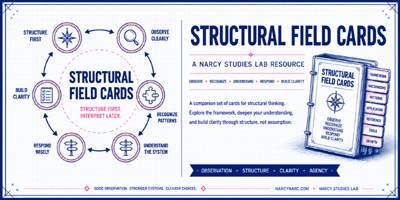
Compact references within the Narcy Studies Lab framework. Each card begins with a questionable event and works through classification, structural placement, possible function, operational elements, outcomes, associations, structural observation, and field guidance.
The NarcyVerse Glossary: Find the Words

Sometimes the hardest part of understanding an interaction is finding the words to describe it.
With more than 400 terms, the NarcyVerse Glossary helps visitors recognize and name observable behaviors, explore established psychological concepts, and discover the language of the NarcyVerse.
Each entry is designed to stand on its own. Throughout the site, linked terms allow you to explore a concept as you encounter it, discover related ideas, and gradually build a clearer understanding of the patterns you observe.
A Trait Is Not a Diagnosis (Just so you know)
Explore the Clinical Context
Anyone can be self-focused, defensive, attention-seeking, or entitled at times. Recognizing an isolated behavior, or perceiving a particular personality trait, does not establish that a person has Narcissistic Personality Disorder (NPD).
Perception is where an observation may begin. It is not necessarily where the conclusion belongs.
What one person perceives as controlling, dismissive, or self-serving may deserve closer examination. The event itself, its context, its frequency, and its effects provide a more useful starting point than immediately assigning a personality label.
The Diagnostic and Statistical Manual of Mental Disorders (DSM-5-TR) describes clinical criteria for NPD. Qualified professionals assess an enduring pattern in context, including its effects on a patient's functioning and relationships.
A diagnosis is intended to inform the patient's understanding and care, not to serve as a verdict for other people about what the patient has done.
Assessment and treatment belong with qualified mental health professionals. NarcyNarc examines observable events, recurring patterns, possible mechanisms, and their effects without diagnosing real people.
Nine DSM Criteria: Explore the Clinical Context
Open each numbered section for a brief educational description. These paraphrases are not a diagnostic checklist. Professional evaluation involves much more than counting traits or recognizing examples in another person.
1. Grandiosity
An exaggerated sense of personal importance or achievements.
2. Fantasies of exceptional success
Preoccupation with fantasies of exceptional success, power, brilliance, beauty, or ideal love.
3. Belief in being special or unique
Believing one is exceptional and should be understood by, or associated with, similarly exceptional people or institutions.
4. Need for excessive admiration
A pronounced need for admiration from others.
5. Entitlement
Unreasonable expectations of favorable treatment or automatic agreement with one's expectations.
6. Interpersonal exploitation
Taking advantage of others to achieve personal aims.
7. Lack of empathy
Difficulty recognizing or identifying with other people's feelings and needs.
8. Envy
Envying others or believing others are envious of oneself.
9. Arrogance
Displaying arrogant or haughty attitudes or behaviors.
Notice: Where Is Controlling Behavior?
Controlling behavior is not a separately listed DSM-5-TR diagnostic criterion for Narcissistic Personality Disorder.
Yet the expression "controlling narcissist" is frequently used to describe difficult or harmful relationship experiences.
The difficulty is that the phrase combines an observation about behavior with a conclusion about the person.
Controlling behavior may be recognizable through repeated demands, restrictions, intimidation, or attempts to influence another person's choices.
Those behaviors can be examined and addressed without determining whether the person displaying them has NPD.
Recognizing control does not require diagnosing the person exercising it.