
The Garage Sale Mishap
One garage sale. One innocent compliment. One accusation nobody heard coming.

He was talking about a neighbor’s house. How did her house end up on trial?
The compliment that changed addresses
Oh, it was a perfectly ordinary garage sale. A few folding tables. Bargains everywhere. Customers and neighbors alike stopping to look and chat. Narcy was hosting, and Main had a little story to tell.
He had helped deliver furniture to a neighbor’s home. And what a home it was. Everything in its place. Beautifully kept. It even smelled like apple pie.
So Main said exactly that. Out loud. In front of everybody.
Now, you might think this was the part where someone asked for the pie recipe. But no. Somewhere between that neighbor’s immaculate house and Narcy’s driveway, Main’s compliment acquired an entirely new address.
Apparently, he had just insulted Narcy’s house.
Funny thing about that: he hadn’t mentioned her house. Not once.
Wait. Whose house are we talking about?
Picture yourself browsing the sale. You hear Main say, “Their place was immaculate. Smelled like apple pie.” Nice, right? A compliment for the people who live there. You might nod and go back to inspecting a lamp with a questionable cord.
But Narcy hears something else: So MY house isn’t immaculate? Is that what you’re telling everyone?
Hold on. How did we get from their home smelled like pie to your home is dirty? Main never made that trip. But nonetheless, the comparison arrived.
Had Narcy just opened up a can of Construed Implication? Well … possibly.
Was it an Attention Disturbance? A little Referential Capture? We can't say for certain what happened inside Narcy's head.
But we can see what happened to Main's words. A Constructed Comparison appeared out of thin air. And through a rather curious bit of Projected Authorship, Main was now being held responsible for making it.
And Main? He was still talking about the apple pie.
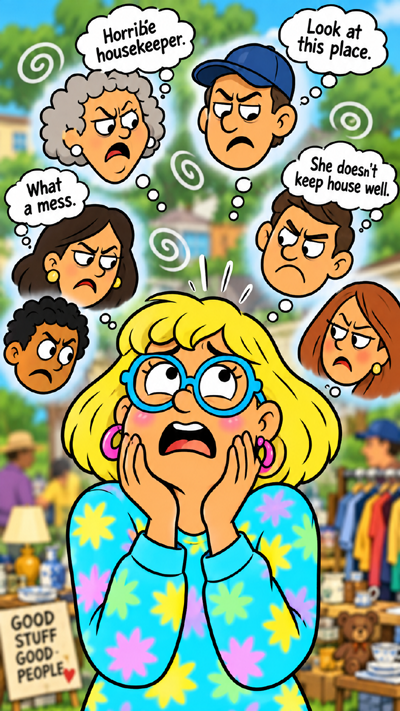
And now Main has a problem.
He can repeat what he said. He can explain who he was talking about. He can even point out that praising one house doesn’t condemn every other house on the block.
But if the response is, “You humiliated me in front of everyone,” he is no longer discussing a furniture delivery. He is being asked to answer for an insult that wasn't in his story.
Notice the little switch? “That hurt my feelings” describes an experience. “You told everyone my house is dirty” makes a claim about what Main did. Those are not the same statement.
And the neighbors?
Well, we don't know what each neighbor thought. Maybe someone was listening. Maybe someone was wondering if that old toaster worked. What we do know from Main’s account is that he praised the home he visited—not Narcy’s, and not anyone else’s by comparison.
Yet if Narcy treats her interpretation as the public event itself, Main may suddenly find himself defending a speech the rest of the driveway never heard.
The really interesting part.
What happens if he says, “I wasn't talking about our house”?
Does that settle the misunderstanding? Or does the next conversation become about why he “wouldn't admit” what he “really meant”? That’s the moment to pay attention to—not as proof of anyone’s hidden motive, but as something you can actually observe.
The truth is.
Any person can misread an implication, especially when feeling exposed, insecure, distracted, or sensitive to comparison. One misunderstanding does not establish a pattern. The structural concern begins when inferred meanings repeatedly become accusations, the speaker's clarification is disallowed, and the grievance remains available for later use.

What Main said: “Their home was immaculate—organized, beautiful, and it smelled like apple pie.”

What Narcy took from it: “My home is dirty, and you just told everyone.”
Have you ever been handed the bill for words you never said?
Not the bill for a clumsy sentence you did say. That one belongs to you. The bill for a second sentence—one somebody supplied, believed, and then put in your mouth.
You can care that a remark landed badly without agreeing that you delivered the accusation attached to it. Main might say: “I hear that you felt compared. I was describing their house. I didn't compare it with ours.”
And here's the boundary: a feeling deserves to be heard. It does not, by itself, establish what another person said or intended.
Ask three little questions: What was actually said? What was heard? And who supplied the part in between?
One misunderstanding can happen to anybody. If the added meaning keeps returning as a settled accusation even after clarification, that is a pattern worth examining.
Main brought the furniture. Narcy brought the comparison. And somehow Main was asked to carry both.
"It was a lovely house. Nobody said it was yours."